Uzgavenes and the spring holidays Lithuanian families keep abroad
Masks, pancakes and the burning of Morė, then Lent, Palm Sunday verbos and Easter eggs: the Lithuanian spring calendar, and how families abroad keep it.
A week ago, on the evening before Ash Wednesday, a small group of us stood in a suburban backyard in Melbourne watching a straw figure in an old dress burn in a steel drum. It was an autumn evening, warm enough for shorts, and there was not a flake of snow within two thousand kilometres. The children, in home-made devil and goat masks, had chased winter out of a garden that had never seen any. Nobody minded. Užgavėnės has never really been about the weather where you are.
Užgavėnės (roughly oo-ga-VAY-nays), the Lithuanian Shrovetide, opens a run of spring holidays that carries families through Lent to Palm Sunday and Easter. This is a guide to each of them, how communities abroad keep them, and a simple plan for a family that wants to mark the season. In 2025 Užgavėnės fell on 4 March; Palm Sunday is on 13 April and Easter Sunday on 20 April.
Užgavėnės: the loud day before the quiet weeks
Užgavėnės is the last day before Lent, the Tuesday before Ash Wednesday, so its date moves with Easter. In the Christian calendar it is the day to finish the rich food before the fast. Underneath that sits an older layer: a noisy, masked festival to drive out winter and wake the spring.
Masks and mummers
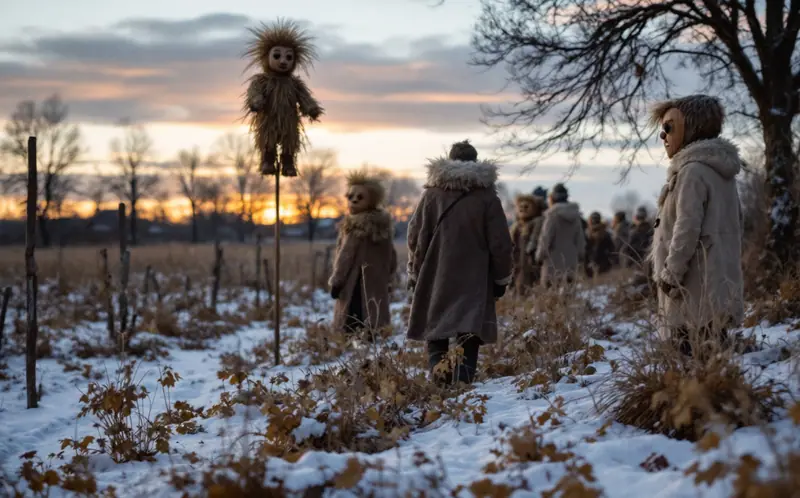
The centre of the day is dressing up. Groups of persirengėliai (people in disguise) go from house to house, or now through the town square, in masks and turned-out sheepskin coats. The traditional figures include devils, witches, goats, horses, cranes, Death with her scythe, old men and beggars. The masks were carved from wood or made from bark, paper and cloth, and some regions, Samogitia in the west especially, are known for their carvers. The mummers sing, play tricks, demand pancakes and are fed so that they will move on.
Lašininis and Kanapinis
The best-known performance is a fight between two figures. Lašininis (from lašiniai, salt pork fat) is fat, well fed and stands for winter and the season of eating. Kanapinis (from kanapės, hemp) is thin, lives on hemp-seed and lenten food, and stands for spring and the fast. They argue, wrestle and trade insults until Kanapinis wins, as spring always beats winter, and Lašininis is driven out.
Morė
At the end of the day comes the burning of Morė, a large straw effigy, often dressed in old women's clothes and set on a pole or a cart. She carries the winter away with her. Crowds gather to watch her burn, and in some places she is also drowned or pushed down a hill on a sledge.
Pancakes, and eating often
Užgavėnės food is heavy and greasy on purpose: pancakes of every kind, potato pancakes, doughnuts, pork. Folk sayings told people to eat many times during the day, nine or twelve times in some versions, so that they would be strong for the year. Children are usually happy to try.
In Lithuania the celebration takes over town squares, and the open-air museum at Rumšiškės near Kaunas is known for one of the largest. Abroad it is smaller, but far from rare.
How Užgavėnės is kept abroad
Many Saturday schools abroad hold Užgavėnės on the nearest weekend. A typical programme runs for a morning or an afternoon:
- Children make masks in class the week before: paper plates, cardboard, wool and paint for the youngest, papier-mâché for older ones.
- The mask parade goes around the hall or the car park, with drums, rattles and as much noise as the caretaker will allow.
- Two older pupils or parents play Lašininis and Kanapinis, usually with a script in simple Lithuanian and a good deal of improvised pushing.
- Pancakes are served, often by the parents' committee, with jam and sour cream.
- A small Morė, built from straw or paper, is burned outdoors if the venue and local rules permit.
On that last point: check the rules. Fire regulations, venue insurance and, in southern hemisphere summers, total fire ban days often decide whether Morė burns or is simply carried out with great ceremony and put in a bin. Plenty of communities do the second. The children still cheer.
If your local school or community group holds an Užgavėnės, it is one of the easiest events to bring a newcomer or a non-Lithuanian partner to. Our piece on how Lithuanian Saturday schools work explains how those schools run their holiday calendars.
Lent: the quiet weeks
After Užgavėnės comes Gavėnia, Lent, the forty days of fasting before Easter. In traditional Lithuanian village life it was a quiet time: no weddings, no dances, plain food and more prayer. Meat and often dairy were given up, and the music stopped.
Most families abroad now keep a lighter version: meatless Fridays, giving something up, perhaps attending the Stations of the Cross at a Lithuanian parish. For children, Lent is mostly the waiting time between pancakes and chocolate eggs.
Early March also brings the feast of St Casimir on 4 March and the Kaziukas fair in Vilnius, a large craft market held around that date, where verbos for Palm Sunday are traditionally sold. Some communities abroad hold their own small Kaziukas fair, with craft stalls, honey cakes and verbos.
Palm Sunday and the verbos
Palm Sunday (Verbų sekmadienis) is the Sunday before Easter. Palms do not grow in Lithuania, so people carried other greenery to church to be blessed: branches of juniper, willow catkins, birch or yew.
In and around Vilnius a special form developed: the Vilniaus verba, a tall, slender bouquet of dried flowers, grasses and herbs, dyed and bound tightly around a stick in bright patterns. They are made through the winter and kept for the year after being blessed.
A blessed verba was thought to protect the house. People tapped each other with it on Palm Sunday morning to wish health, with a rhyme that comes in several versions; a common one runs: Ne aš mušu, verba muša, už savaitės Velykos, "It is not me who strikes, the verba strikes; in a week it will be Easter".
Abroad, families improvise. Willow catkins, florist's dried grasses, a sprig of rosemary or conifer from the garden: any of these goes to church in place of juniper. A few parishes and community groups run verba-making workshops in Lent.
Easter: margučiai and the morning table
Easter (Velykos) is the great feast of spring. In Lithuanian families it starts with church, in the early morning or at the Easter Vigil the night before, and continues with a breakfast that breaks the fast. Eggs are the first thing eaten.
Margučiai
The decorated Easter eggs are called margučiai. The most common ways to make them:
- Onion-skin dyeing: eggs boiled with plenty of brown onion skins turn shades of amber to deep red-brown. Leaves or flowers pressed against the shell under a stocking leave pale shapes.
- Wax resist: patterns are drawn on the egg with melted wax using a pin or a nib, then the egg is dyed; the waxed lines stay pale.
- Scratching: a dyed egg is decorated by scratching fine patterns into the colour with a sharp blade, which takes patience and steady hands.
Children usually start with onion skins and graduate to wax.
Egg games
At the table, people knock eggs together, end to end. The one whose egg stays whole wins the other's egg. Outside, or on the floor, eggs are rolled down a little wooden or cardboard ramp to hit other eggs; whoever's egg strikes another takes it.
The Easter Granny
In Lithuanian tradition, Easter eggs are brought to children by Velykė, the Easter Granny, rather than by a rabbit. Families abroad often keep both, which children consider an excellent arrangement.
In some regions, Dzūkija in the south especially, groups of young men called lalauninkai once went from farm to farm on Easter night or at dawn, singing Easter songs, wishing the household a good harvest and collecting eggs. The custom, lalavimas, faded in the twentieth century and has been revived in some villages. Easter Monday, the second day of Easter, is for visiting relatives.
A simple family plan for the season
| When | What to do | Time needed |
|---|---|---|
| Week before Užgavėnės | Make masks with the children; find a pancake recipe | 1 or 2 evenings |
| Užgavėnės | Pancake supper; a small Morė from straw or paper; noise | One evening |
| First week of Lent | Agree on one family Lent practice | A conversation |
| Early March | Visit a Kaziukas fair if there is one near you, or bake honey cakes | A morning |
| Week before Palm Sunday | Make a simple verba from dried grasses, or cut willow | An afternoon |
| Palm Sunday | Take the verba to church; tap the family awake with the rhyme | 5 minutes |
| Holy Saturday | Dye eggs with onion skins; try wax on a few | 2 hours |
| Easter Sunday | Breakfast with eggs first; egg tapping; Velykė's basket | A morning |
| Easter Monday | Visit relatives or call grandparents; egg rolling | A day |
Onion-skin eggs, in outline
Save brown onion skins for two or three weeks. Fill a pan with skins and water, simmer for half an hour, then add white or light brown eggs and boil for ten to fifteen minutes. For patterns, press a small leaf onto each raw egg, wrap it tightly in a piece of old stocking and tie it before boiling. Rub the finished eggs with a drop of oil for shine.
Common questions
Do we need to be religious to keep these holidays?
No. Užgavėnės is largely a folk festival, and many families keep margučiai and the egg games without going to church. Others keep the religious side fully. Both are common.
What if we live where March is autumn?
Keep the dates and the customs and enjoy the joke. Chasing winter out of an autumn garden is a very diaspora thing to do.
Is there a Lithuanian Easter dish we should make?
Eggs come first, then whatever the family's Easter table holds: cold meats, a cake or a boba (a tall yeast cake), salads. Like the Christmas Eve supper described in our piece on Kūčios abroad, the shape of the meal matters more than the exact menu.
More seasonal traditions are in the traditions circle. With Užgavėnės behind us and Palm Sunday five weeks off, now is the time to start saving onion skins, because by Holy Saturday you will want twice as many as you think.

Egle Matulis
Egle lives in Melbourne, sings in a folk ensemble and cooks for more Christmas Eve tables than she can count. She writes about traditions, food, song and craft.