Emigrant letters as family history: reading what great-grandparents wrote home
A bundle of old Lithuanian letters can hold more family history than any record. How to read the handwriting and spelling, translate, store and share them.
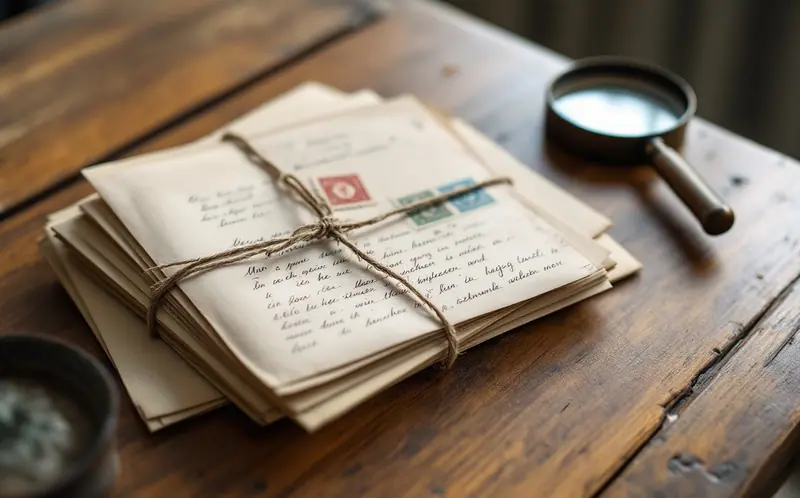
Most Lithuanian families abroad have a box somewhere. It might be a biscuit tin in a grandmother's wardrobe or a shoebox that turned up when a house was cleared: thin envelopes with foreign stamps, pages folded into small squares, handwriting that slopes across the paper and then turns sideways to fill the margins. Nobody in the family can quite read it, so it goes back in the cupboard.
Those letters are often the best family history you will ever find. Parish registers give you dates. Ship manifests give you a port and a destination. Letters give you voices: who was ill, what the harvest was like, which cousin had married badly, how much a farmhand earned in Pennsylvania compared with a season's work at home. This guide covers what kinds of letters survive, how to read them, how to get them translated, and how to keep them safe for the next generation.
What kinds of letters turn up
Lithuanian family letters tend to come from a few recognisable periods, and knowing which one you are holding helps you read it.
| Period | Typical letters | What to expect |
|---|---|---|
| Before 1914 | Letters between villages and the mining and mill towns of America, Scotland and elsewhere | Old spelling, dialect, many letters written by someone else for the sender |
| Between the wars | Letters between independent Lithuania and relatives in the Americas | More schooling, standard spelling spreading, photographs enclosed |
| 1944 to the 1950s | Letters from displaced persons camps in Germany and Austria, then from new homes overseas | Careful, educated hands; worry about relatives left behind |
| Soviet decades | Letters between Soviet Lithuania and the West | Cautious wording, gaps, news hidden in family references |
The movements behind these periods are traced in our overview of the waves of Lithuanian emigration, which is worth reading alongside any bundle you inherit.
Reading the handwriting
Most letters are in Latin cursive, not Cyrillic, even from the decades of the press ban (1864 to 1904), when printing Lithuanian in the Latin alphabet was forbidden in the Russian Empire. People still wrote by hand in Latin letters, and many learned to read and write at home or from teachers working outside the law.
Practical habits help:
- Start with the envelope: Addresses, postmarks and stamps often tell you the town and the date before you read a word of the letter.
- Find the names first: Personal names and place names are the easiest words to recognise and they anchor everything else.
- Build an alphabet sheet: Copy out each letter shape as you identify it from words you already know. After two or three pages, the writer's habits become predictable.
- Enlarge everything: A good scan viewed at 200 or 300 percent on a screen is far easier than paper under a lamp.
Many early letters were dictated. A villager who could not write would ask a neighbour, the organist or a schoolchild, so the handwriting may change from one letter to the next while the voice stays the same. Signatures can be in yet another hand.
Reading the spelling
Standard Lithuanian spelling settled only in the early twentieth century, so older letters can look strange even to fluent speakers.
- Polish-style letters: Before the 1900s, many writers used sz for š and cz for č, as in Polish. The Czech-style š and č took over only in the first years of the twentieth century, and older writers kept the old habits for decades.
- W for v: A w in a word or surname was usually a v.
- Missing marks: Writers often left out the small marks entirely, so ą, ę, ė, į, ų and ū appear as plain vowels.
- Spelling by ear: People wrote as they spoke, so dialect shows clearly. A letter from Samogitia (Žemaitija) can look very different from one written in Dzūkija.
- Borrowed words: Letters from America pick up English words with Lithuanian endings, words for job, shop, boss and store among them. In Britain and Canada the same thing happened with local vocabulary.
Old letters also follow a pattern. Many open with a religious greeting such as Garbė Jėzui Kristui (Praise be to Jesus Christ), then reassure the reader that the writer is alive and well, then send long lists of greetings to relatives by name. Those lists are genealogical gold: they tell you who was alive, who was married to whom, and who lived nearby.
Reading between the lines
Letters from Soviet Lithuania need a different kind of attention. Writers knew mail could be opened, and many avoided politics, deportations and anything that might cause trouble. News could be wrapped in family language: a relative "who went to visit the far north" might be someone deported to Siberia. Gaps in a correspondence can be as informative as the letters themselves. Read these with care and without assuming you know what was meant; compare them with other sources before you draw conclusions.
Getting the letters translated
You have three main options, and many families combine them.
- A relative or friend: A fluent older speaker often reads old letters better than a professional, because dialect and old spelling are familiar. Ask them to read aloud and record it, then type it up.
- Machine translation, carefully: Online tools can give a first rough meaning, but only from a clean typed transcription in modern spelling. They do badly with handwriting, dialect and the old sz and cz forms.
- A paid translator: For a key letter, a translator with experience of historical texts is worth the cost. Send good scans, your transcription if you have one, and a list of the family names and places so they are not guessed.
Whichever route you take, work in two stages. First a transcription in Lithuanian that keeps the original spelling, line by line, with uncertain words marked like this: [?]. Then a translation in English. Keeping both means a better reader can correct the transcription years later without starting again.
A worked example
Say a woman in Ohio inherits twelve letters written to her great-grandfather, who left a village near Raseiniai around 1905. Here is how she might work through them over a few weekends:
- Weekend one: She sorts the letters by postmark date, numbers them in pencil on the back of a separate sleeve (never on the letter), and scans every page and envelope.
- Weekend two: She lists every personal name and place name she can read, and compares them with the parish records described in our guide to tracing Lithuanian ancestors.
- Weekend three: A cousin in Lithuania reads the two most important letters aloud on a video call. She records the call with permission and types up what she hears.
- Weekend four: She writes a one-page summary of each letter in English, with a family tree sketch showing everyone mentioned.
By the end she has a story nobody in her family knew, a list of second cousins to look for, and a set of files that will survive whatever happens to the paper.
Keeping the paper safe
Old letters are fragile but not difficult to protect.
- Store them flat, unfolded where the paper allows it, in acid-free folders or sleeves, inside a box kept in a cool, dry room. Attics and basements are the worst places.
- Remove rusty paper clips, pins and rubber bands. Do not use sticky tape, and never laminate.
- Handle them with clean, dry hands. Cotton gloves are not necessary for paper and can make you clumsy.
- Keep envelopes with their letters. The postmark is part of the record.
- If a letter is torn or crumbling, ask a conservator before trying any repair.
Scan at 600 dpi in colour, both sides of every sheet and every envelope, and save the files in two places, one of them away from the house. Name files in a way that sorts by date, such as 1923-04-letter-from-Raseiniai-p1.
Sharing them
Letters belong to the whole family, not only to whoever has the box. A simple PDF with scans, transcriptions and translations, sent to every branch of the family, is often the most useful thing you can make. A printed booklet works well for older relatives.
Be thoughtful about publishing letters online. They may mention people who are still alive, family quarrels, illnesses or political trouble. Ask the closest descendants before you post anything, and leave out what could hurt someone.
If the family eventually decides to give the originals away, Lithuanian emigrant archives and research centres in North America and in Lithuania collect exactly this kind of material. Our reference page on Lithuanian emigrant archives describes the main collections and what they hold. Ask before sending anything, and keep your scans: the archive will care for the paper, but the family story will live in the copies you share.

Linas Margevicius
Linas lives in Toronto and has spent many winters in parish basements and reading rooms leafing through emigrant newspapers. He writes about diaspora history, archives and the press.